Garage floor coatings · Sun City, AZ
A cleaner, brighter garage floor — built to last for years.
We turn dusty, stained garage concrete into a sealed, attractive floor that handles cars, golf carts, storage and hobbies with ease.
Why so many garage floors look tired
Concrete is porous. Every drip of oil, splash of sprinkler water and bit of tracked-in fertilizer soaks a little way into the surface. Over the years that adds up to blotchy stains that no amount of scrubbing removes. Meanwhile, the top of the slab slowly wears, releasing the fine gray dust that settles on shelving, storage boxes and the hood of the car.
Many garages around Sun City were painted at some point, too. Garage paint looks lovely for a season or two, then starts to peel where the tires sit. Hot tires soften thin paint, grip it as they cool, and lift it off a little more every time the car comes home. Before long the floor looks worse than bare concrete did.
A professionally installed garage coating solves these problems at the source. It seals the concrete so stains stay on the surface, stops the dusting entirely, and is bonded deeply enough to stand up to hot tires. The finished floor is easier to keep clean and makes the whole garage feel brighter and more organized.
Designed around golf carts, storage and everyday use
In this community the garage is rarely just for parking. One bay often belongs to a golf cart, complete with a charger on the wall. There may be a second refrigerator or chest freezer, a workbench, garden tools and a wall of cabinets. Each of those adds its own demands on the floor.
Golf carts are light, but their tires pivot tightly on the same patch of concrete every day, and battery chargers can occasionally drip. Freezers and refrigerators sometimes leave condensation marks. Workbench areas see dropped screws, paint and the odd spill of solvent. A full flake system with a chemical-resistant topcoat handles all of it, and the speckled pattern keeps small marks from showing.
We also think about how you move through the space. If you step down from the house into the garage, we can add a little extra grit near the door. If the floor slopes toward the driveway, we make sure the coating finishes neatly at the edge so it doesn’t catch a shoe or a cart tire.

Garage coating options
There is no single “right” garage floor. These are the systems we install most often, and we’ll recommend one after seeing your slab and hearing how you use the garage.
- Full-broadcast flake
- Colored flakes cover the base coat completely, then a clear topcoat seals them in. This is the most forgiving finish for dust, dirt and tire marks, with a gentle texture underfoot. It suits nearly every garage.
- Light flake over a solid color
- A lighter sprinkle of flake over a solid base gives a cleaner, more modern look. It shows dust a little more readily, so it’s best for tidy garages with less traffic.
- Solid color with clear topcoat
- A uniform gray, beige or tan floor. It makes it easy to spot dropped screws at the workbench and has a crisp, simple appearance.
- One-day polyaspartic system
- Fast-curing materials let us complete the whole floor in a single visit, so you’re without your garage for the shortest possible time.
How we coat a garage floor
- 1
Empty the garage
Everything sitting on the floor needs to be moved out. Wall-mounted cabinets and shelves can stay. If moving heavy items is a concern, let us know when we schedule.
- 2
Protect and grind
We cover the walls and door to the house, then grind the concrete with diamond tooling connected to a vacuum. This removes old paint and sealers and opens the surface so the coating can bond.
- 3
Fill and smooth
Cracks, chips and pitted spots are filled and ground flush. Expansion joints are cleaned out and finished to your preference.
- 4
Base coat and flake
A tinted base coat goes down, and flakes are broadcast by hand while it is still wet until the surface is fully covered.
- 5
Scrape, clean and seal
Once cured, loose flakes are scraped and vacuumed away and a clear, UV-stable topcoat seals everything in.
- 6
Walkthrough
We review the finished floor with you and confirm when you can walk, park the car and bring the cart back in.
Free in-home estimate
Thinking about garage floor coatings?
We’ll visit, look at the concrete, bring samples and give you a written estimate — no pressure.
What makes a professional installation different
Retail epoxy kits rely on an acid wash to prepare the concrete. On an older slab that has been painted, sealed or soaked with oil, an acid wash simply can’t do the job, and the kit coating ends up sitting on top of a weak surface. That is why so many DIY floors begin peeling within the first year.
Our systems are also considerably thicker, and they use commercial-grade materials with much stronger bonding and wear resistance. We repair cracks rather than covering them, test for moisture coming up through the slab, and finish the edges and transitions by hand. The difference shows years later, when the floor still looks good.
Garage floors in the Sun City climate
Summer heat is the dominant factor here. Garages can become extremely hot, and a car pulling in on a July afternoon brings hot tires onto the floor. We use topcoats rated for hot-tire resistance, and we schedule summer installs for early mornings when the slab is coolest.
Sunlight matters too. With the garage door open, afternoon sun can reach well into the space. Standard epoxy yellows under UV exposure, so our garage floors are finished with a UV-stable topcoat that keeps the colors true.
Finally, the monsoon season brings dust and occasional heavy rain. A sealed floor is easy to sweep and rinse after a storm, and the flake texture keeps it from becoming slick when water blows in under the door.
Choosing a color that suits your home
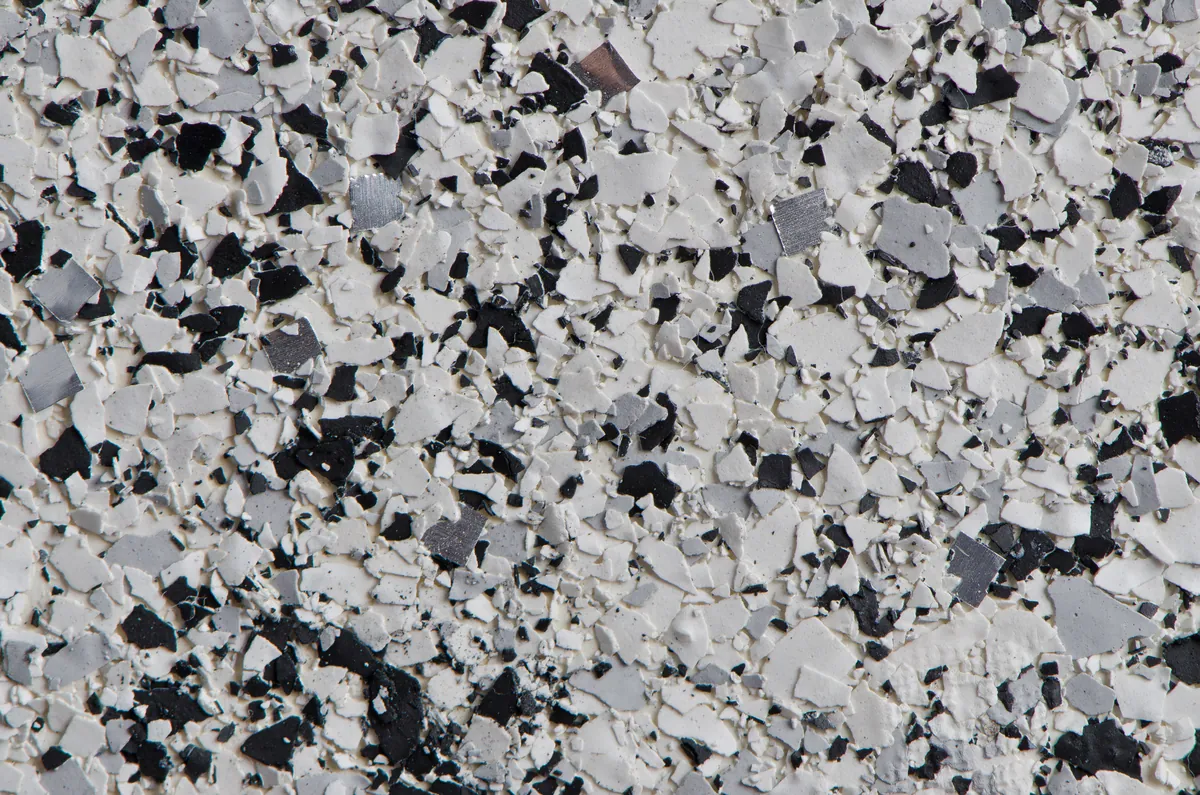
Color is the fun part, and it’s worth a little thought. Mid-tone blends — soft grays mixed with tan, or taupe with cream and charcoal — are the easiest to live with because they hide the light desert dust that blows under every garage door. Very light floors look stunning on day one but show tire marks sooner. Very dark floors show dust and pollen.
It also helps to look at what surrounds the floor. Many homes here have white or almond garage doors, light stucco and neutral cabinets. A blend that picks up one of those tones ties the space together. If you have a favorite accent color, a few flakes of it mixed into a neutral base can add personality without overwhelming the room.
We always bring physical sample boards to the estimate, and we encourage you to set them on the floor with the garage door open and closed. Color reads very differently in bright Arizona daylight than it does under a single overhead bulb.
Looking after your new garage floor
Day-to-day care is simple. A dust mop or soft push broom keeps the surface clean. Every so often, mop with warm water and a little pH-neutral cleaner, then squeegee toward the door. Skip acidic cleaners and scouring powders; over the years they take the shine off the clear coat.
Wipe up oil or battery drips when you notice them, and consider a small mat under the golf cart charger and in front of the workbench. A drip tray under a car that sits for long stretches will keep that spot spotless.
Questions we’re often asked
How soon can I use my garage again?
On a one-day polyaspartic floor, most people are walking across it by the following morning and parking again a few days later. Epoxy-based systems and cooler weather can add a little time. We’ll give you exact guidance for your floor.
Can you coat over my old garage paint?
We remove it. Coating over old paint means the new floor is only as secure as the paint underneath. Grinding it off ensures the coating bonds directly to the concrete.
Will hot tires damage the floor?
Our systems are designed to resist hot-tire pickup, which is the main reason painted floors fail. Occasional tire marks can appear on any surface but clean up easily.
Do I have to move everything out?
Yes, everything that sits on the floor. Wall-mounted storage can stay where it is. We’re happy to talk through options if you need help planning.
Can you coat the floor around my water heater and water softener?
Yes. We work carefully around fixed appliances and seal the edges neatly. If something can be moved safely and briefly, coating underneath it gives the most complete result; we’ll talk through what makes sense.
Is the coating safe to walk on in socks or slippers?
A flake floor has a mild texture that gives good footing. If you often step into the garage in slippers, we can add a fine grit to the topcoat near the house door for extra peace of mind.
What colors are available?
Dozens of flake blends, from soft grays and taupes to warmer desert tones. Sample boards come with us to the estimate, so you can judge colors under your own garage lights.

Ready for a garage floor you’re proud of?
Schedule a free visit and we’ll bring samples, test the concrete and give you a clear written estimate.